
Podcast: Play in new window | Download | Embed
Subscribe Apple Podcasts | Spotify | Android | Email | RSS | More
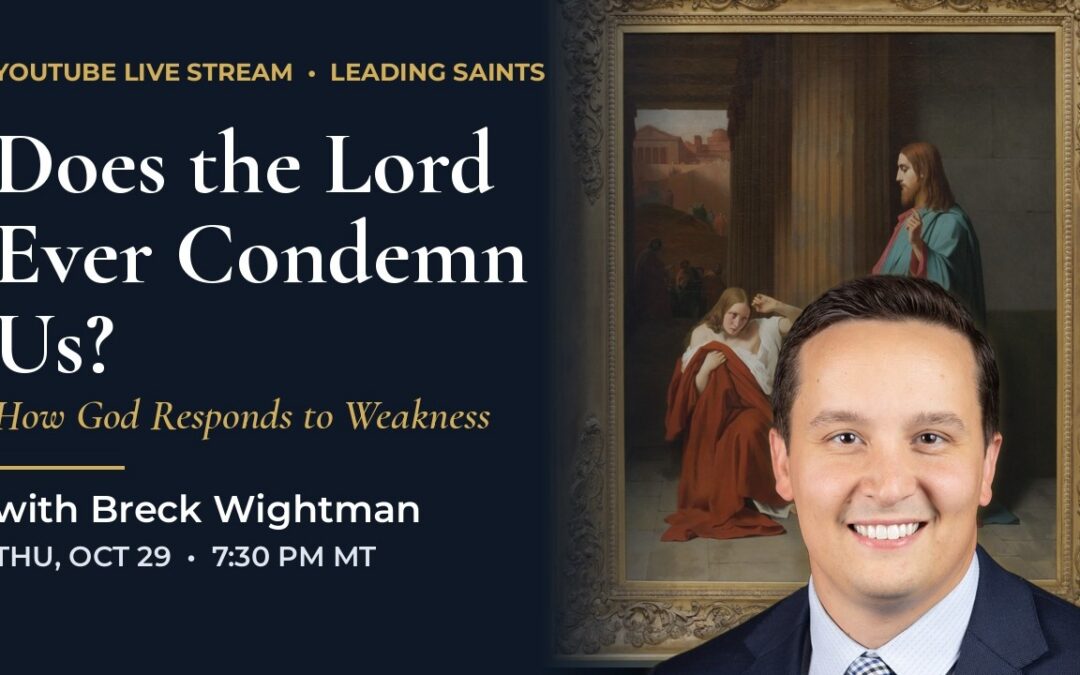
When a woman taken in adultery—a capital crime under Mosaic law—was brought before the Savior, He didn’t condemn her. He said, “Go, and sin no more.” Why? BYU professor Breck Wightman joins us to explore how the Lord really responds to our sins, and why it may be different than you think.
Breck Wightman is an Assistant Professor in the Romney Institute of Public Service and Ethics at Brigham Young University, where he teaches human resource management, economics, and public policy in the MPA program. His research focuses on leadership, succession, hiring, and person-organization fit. In addition to his academic work, he owns a speaking and training company and is a regular presenter at BYU Education Week.
Within the Church, Breck recently completed his service in a bishopric and currently serves on his stake high council.
Links
Breck Wightman’s PowerPoint Slides
Share your thoughts in the Zion Lab community
Transcript available in the Zion Lab community

Highlights
In this conversation, Breck outlines a scriptural framework distinguishing willful rebellion and hypocrisy from mortal weakness, explaining how understanding divine mercy transforms personal discipleship and ecclesiastical leadership.
00:04:28 – Formulating the Topic: How God Responds to Weakness
00:05:22 – Scriptural Episode: The Woman Taken in Adultery
00:10:32 – Understanding Sin and Its Consequences
00:11:25 – Defining Sin: Law and Knowledge
00:12:32 – Accountability and Covenant Relationships
00:16:07 – The Nature of Weakness vs. Rebellion
00:22:10 – Exploring Rebellion: Active vs. Passive
00:25:33 – Consequences of Rebellion
00:26:04 – Sons of Perdition: The Worst Form of Rebellion
00:30:01 – The Complexity of Sin and Stigma
00:33:13 – Understanding Hypocrisy in Actions
00:40:05 – The Nature of Weakness and Its Implications
00:44:28 – The Lord’s Perspective on Weakness vs. Rebellion
Key Insights
Types of Sin: The discussion emphasizes that not all sins are equal. Sin can be categorized into rebellion, hypocrisy, and weakness, each eliciting different responses from God.
Rebellion vs. Weakness: Rebellion involves a willful rejection of God’s commandments, while weakness reflects a sincere desire to do good but falling short due to human limitations. God responds to rebellion with consequences, whereas He approaches weakness with mercy.
Intentions Matter: The motivations behind actions are crucial. Good actions with bad intentions lead to hypocrisy, while bad actions with good intentions indicate weakness. Understanding this distinction can help individuals and leaders navigate their spiritual journeys.
Scriptural Examples: The episode references the story of the woman taken in adultery to illustrate how Jesus showed mercy to those who struggle with weakness, contrasting this with His condemnation of the hypocritical Pharisees.
Grace and Accountability: The conversation highlights that accountability increases with knowledge of the law, but God’s grace allows for growth and learning over time. Leaders should recognize that individuals may be in different stages of understanding and repentance.
Leadership Applications
Fostering Compassion: Latter-day Saint leaders can cultivate a compassionate environment by recognizing the difference between weakness and rebellion in their congregants, offering support rather than condemnation.
Encouraging Open Dialogue: Leaders should create spaces for honest discussions about struggles with sin, allowing members to express their weaknesses without fear of judgment, thereby promoting healing and growth.
Tailoring Responses: Understanding the nuances of sin can help leaders tailor their counsel and support to meet the specific needs of individuals, focusing on mercy and encouragement rather than strict punitive measures.
The award-winning Leading Saints Podcast is one of the top independent Latter-day Saints podcasts as part of nonprofit Leading Saints’ mission to help Latter-day Saints be better prepared to lead. Find Leadership Tools, Courses, and Community for Latter-day Saint leaders in the Zion Lab community. Learn more and listen to any of the past episodes for free at LeadingSaints.org.
Past guests include Emily Belle Freeman, David Butler, Hank Smith, John Bytheway, Reyna and Elena Aburto, Liz Wiseman, Stephen M. R. Covey, Benjamin Hardy, Elder Alvin F. Meredith III, Julie Beck, Brad Wilcox, Jody Moore, Tony Overbay, John H. Groberg, Elaine Dalton, Tad R. Callister, Lynn G. Robbins, J. Devn Cornish, Bonnie Oscarson, Dennis B. Neuenschwander, Kirby Heyborne, Taysom Hill, Coaches Jennifer Rockwood and Brandon Doman, Anthony Sweat, John Hilton III, Barbara Morgan Gardner, Blair Hodges, Whitney Johnson, Ryan Gottfredson, Greg McKeown, Ganel-Lyn Condie, Michael Goodman, Wendy Ulrich, Richard Ostler, and many more in over 800 episodes.
Discover podcasts, articles, virtual conferences, and live events related to callings such as the bishopric, Relief Society, elders quorum, Primary, youth leadership, stake leadership, ward mission, ward council, young adults, ministering, and teaching.


